Methods and Pass-by-value¶
1. What is it¶
A method is a named block of code that encapsulates a specific task and can be reused as many times as needed.
public— access modifierstatic— class-level, no object needed to call itint— return typeadd— method name (camelCase)(int a, int b)— parameter list (type + name per pair)- Method body:
returnsends the result back to the caller.
Calling a method:
2. Why it matters¶
Methods are the basic unit of code organisation in Java:
- DRY (Don't Repeat Yourself) — write logic once, call it anywhere
- Testability — small methods are easy to test in isolation
- Readability — a well-named method is self-documenting
- Pass-by-value is the foundational concept that explains why Java code behaves the way it does — a very common interview topic
3. Declaring a method¶
Full syntax¶
Return types¶
// void — returns nothing
static void printHello() {
    System.out.println("Hello");
}

// Returns a value
static int square(int n) {
    return n * n;
}

// Early return — exits as soon as the result is known
static boolean isEven(int n) {
    return n % 2 == 0; // no if/else needed
}
One method, one job
If a method name needs the word "and" (e.g. validateAndSave), that is a sign it should be split into two separate methods.
Every branch must return a value¶
static int divide(int a, int b) {
    if (b != 0) return a / b;
    // ❌ compile error — no return here
}

static int divide(int a, int b) {
    if (b != 0) return a / b;
    return 0; // ✅ every branch has a return
}
4. Pass-by-value¶
Java always passes arguments by value. No exceptions.
This means: the method receives a copy of the value passed in — not the original variable itself.
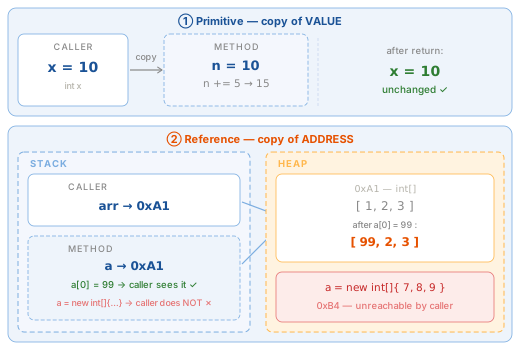
With primitives — copy of the value¶
static void addFive(int n) {
    n += 5; // modifies the copy, not the original
}

int x = 10;
addFive(x);
System.out.println(x); // 10 — x is unchanged
With objects / arrays — copy of the address¶
static void changeFirst(int[] arr) {
    arr[0] = 99; // modifies the object's contents via the address — caller sees this
}

static void reassign(int[] arr) {
    arr = new int[]{7, 8, 9}; // modifies only the local variable — caller does NOT see this
}

int[] scores = {1, 2, 3};
changeFirst(scores);
System.out.println(scores[0]); // 99 — object content was changed

reassign(scores);
System.out.println(scores[0]); // still 99 — caller's variable was not changed
\"Pass-by-reference\" is the wrong term for Java
Java passes a copy of the address, not the variable itself. You can mutate the object's contents through the copied address, but you cannot reassign the caller's variable.
5. Method overloading¶
Same method name, different parameter list — Java picks the correct method at compile time based on argument types and count.
static int    add(int a, int b)        { return a + b; }
static double add(double a, double b)  { return a + b; }
static int    add(int a, int b, int c) { return a + b + c; }

add(1, 2);     // calls add(int, int)
add(1.0, 2.5); // calls add(double, double)
add(1, 2, 3);  // calls add(int, int, int)
Return type does not differentiate overloads
Java resolves overloads purely from the parameter list, not the return type.6. Varargs — variable number of arguments¶
Allows passing any number of arguments — inside the method they are treated as an array.
static int sum(int... numbers) { // numbers is int[]
    int total = 0;
    for (int n : numbers) total += n;
    return total;
}

sum();           // 0
sum(1);          // 1
sum(1, 2, 3);    // 6
sum(1, 2, 3, 4); // 10
// Varargs must be the last parameter
static String format(String template, Object... args) {
    return String.format(template, args);
}
7. Static vs instance methods¶
public class MathUtils {

    // Static — no object needed, called via the class name
    public static int abs(int n) {
        return n < 0 ? -n : n;
    }
}

int result = MathUtils.abs(-5); // 5
public class Counter {
    private int count = 0; // instance field

    // Instance — needs an object, can access instance fields
    public void increment() { count++; }
    public int  getCount()  { return count; }
}

Counter c = new Counter();
c.increment();
c.increment();
System.out.println(c.getCount()); // 2
| Static method | Instance method | |
|---|---|---|
| Called via | Class name | Object |
| Access instance fields | No | Yes |
| Use when | Utility, no state needed | Needs object state |
8. Recursion¶
A method that calls itself. Every recursive method needs two parts: a base case (stopping condition) and a recursive case (calls itself with a smaller problem).
static int factorial(int n) {
    if (n <= 1) return 1;           // base case
    return n * factorial(n - 1);    // recursive case
}
Call stack trace — factorial(4)¶
Each recursive call pushes a new stack frame onto the call stack. Once the base case is hit, frames are popped LIFO and results propagate back up:
factorial(4)           ← frame 0: n=4, waiting for factorial(3)
  factorial(3)         ← frame 1: n=3, waiting for factorial(2)
    factorial(2)       ← frame 2: n=2, waiting for factorial(1)
      factorial(1)     ← frame 3: n=1, base case → returns 1

      ← 1              pop frame 3
    ← 2 * 1 = 2        pop frame 2
  ← 3 * 2 = 6          pop frame 1
← 4 * 6 = 24           pop frame 0 → final result
Fibonacci — the call tree¶
static int fibonacci(int n) {
    if (n <= 1) return n;
    return fibonacci(n - 1) + fibonacci(n - 2); // each call spawns two branches
}
Each call splits into two branches — the tree grows exponentially. Orange nodes are recomputed unnecessarily:
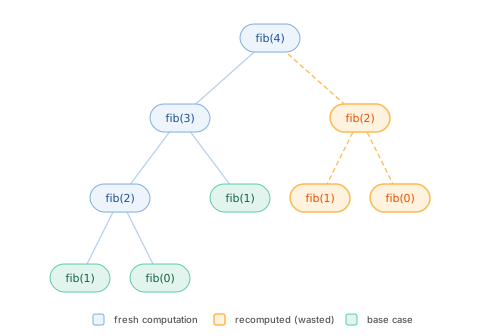
fib(30) ≈ 1 million calls. Optimisation techniques (memoization, dynamic programming) are covered in Phase 2.
Simple example — sum of digits¶
// sumDigits(1234) = 4 + sumDigits(123) = 4 + 3 + sumDigits(12) = ... = 10
static int sumDigits(int n) {
    if (n < 10) return n;                 // base case: single digit
    return n % 10 + sumDigits(n / 10);   // last digit + rest
}
When to use recursion
Use recursion when the problem naturally decomposes into smaller sub-problems of the same shape: tree traversal, binary search, quicksort, mergesort. If a loop works — use the loop.
Recursion without a base case → StackOverflowError
Every method call pushes a new stack frame onto the call stack. The JVM defaults to roughly 500–1,000 nested frames. Deep recursion (n > 10,000) should use a loop instead.
9. Code example¶
Verified
Full compilable source: MethodsDemo.java
- Varargs
double... nums— callable with any number of arguments including zero. Inside the method it is a plaindouble[]. doubleAllreceives a copy of the address ofarr. Both copies point to the same array on the Heap — so changes througharr[i]are visible to the caller.- Euclid's algorithm for the greatest common divisor: clean recursion, easy to read, and runs in ~log(min(a,b)) steps.
10. Common mistakes¶
Mistake 1 — Expecting a primitive to be modified by a method¶
static void reset(int n) { n = 0; }

int count = 5;
reset(count);
System.out.println(count); // ❌ expects 0 but prints 5

// ✅ return the new value instead
static int reset() { return 0; }
count = reset();
Mistake 2 — Expecting a reassigned reference to affect the caller¶
static void clear(int[] arr) {
    arr = new int[arr.length]; // ❌ only changes the local variable
}

static void clear2(int[] arr) {
    Arrays.fill(arr, 0);       // ✅ modifies the object's contents
}
Mistake 3 — Missing return in a branch¶
static String grade(int score) {
    if (score >= 50) return "Pass";
    // ❌ compile error — what if score < 50?
}

static String grade(int score) {
    if (score >= 50) return "Pass";
    return "Fail"; // ✅
}
Mistake 4 — Ambiguous overload¶
static void process(int a, double b)    { }
static void process(double a, int b)    { }

process(1, 2); // ❌ ambiguous — compiler cannot choose
process(1, 2.0); // ✅ calls process(int, double)
Mistake 5 — Recursion without a base case¶
static int sum(int n) {
    return n + sum(n - 1); // ❌ never stops → StackOverflowError
}

static int sum(int n) {
    if (n <= 0) return 0;       // ✅ base case
    return n + sum(n - 1);
}
11. Interview questions¶
Q1: Is Java pass-by-value or pass-by-reference?
Java is always pass-by-value. For primitives, the value is copied. For objects, the address (reference) is copied — so you can modify the object's contents inside a method, but you cannot reassign the caller's variable. Many people incorrectly call this "pass-by-reference."
Q2: How does method overloading differ from method overriding?
Overloading — same name, different parameters, within the same class, resolved at compile time. Overriding — a subclass redefines a superclass method with the same signature, resolved at runtime (dynamic dispatch). Overriding is the foundation of Polymorphism, covered in the OOP phase.
Q3: What is varargs? What are its limitations?
Varargs (
Type... name) allows passing zero or more arguments of the same type — it is a plain array inside the method. Limitations: (1) only one varargs per method, (2) must be the last parameter, (3) indistinguishable from passing an array directly, (4) varargs overloads can easily become ambiguous.
Q4: When should a method be static versus instance?
Static when the logic does not depend on object state — utility methods, factory methods, helper functions (e.g.
Math.abs(),Arrays.sort()). Instance when the logic needs to read or modify a field of the object. If a method does not use any instance field, that is usually a sign it should be static.
Q5: Why can recursion cause a StackOverflowError?
Each method call pushes a new stack frame onto the call stack — holding parameters, local variables, and the return address. The call stack has a fixed size limit (typically 512 KB–1 MB). Deep recursion with a missing or unreachable base case creates thousands of frames until the stack overflows. Solutions: convert to a loop, or simulate recursion with an explicit stack data structure.
12. References¶
| Resource | Content |
|---|---|
| JLS §8.4 — Method Declarations | Official specification |
| Oracle Tutorial — Methods | Official tutorial |
| Oracle Tutorial — Passing Info to Methods | Pass-by-value explained |
| Clean Code — Robert C. Martin | Chapter 3: Functions — small, do one thing, no side effects |
| Effective Java — Joshua Bloch | Item 53: Use varargs judiciously |