OOP — Class and Object¶
1. What is it¶
A class is a blueprint that describes a type of entity: what data it holds (fields) and what it can do (methods).
An object is a concrete instance created from that class. One class can produce an unlimited number of objects.
// Class — the blueprint
class Dog {
    String name;
    int age;

    void bark() {
        System.out.println(name + " says: Woof!");
    }
}

// Objects — concrete instances
Dog rex  = new Dog();
Dog luna = new Dog();
// rex and luna are two separate objects, both from class Dog
2. Why it matters¶
OOP is the foundation of Java and virtually every modern backend framework:
- Spring Boot is built around beans — objects managed by the Spring container
- JPA/Hibernate maps Java classes to database tables
- Design patterns (Factory, Strategy, Builder...) are all built on class hierarchies
Understanding class/object, static/instance, and the three methods toString() / equals() / hashCode() is the minimum requirement for working with any real Java codebase.
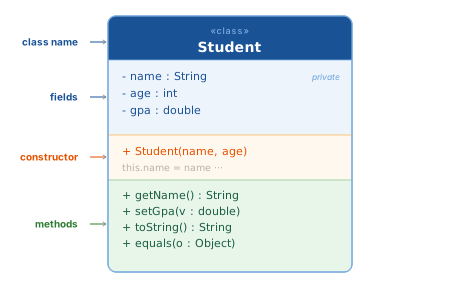
3. Class anatomy¶
Fields — data¶
Fields (also called instance variables) store the state of each object.
Each object has its own copy of instance fields — changing a field on one object does not affect any other.
Methods — behavior¶
Methods define what an object can do.
class Product {
    String name;
    double price;
    int    quantity;

    double totalValue() {
        return price * quantity;
    }

    void restock(int amount) {
        quantity += amount;
    }
}
Naming conventions¶
| Element | Convention | Example |
|---|---|---|
| Class | PascalCase | BankAccount, ProductService |
| Field | camelCase | firstName, accountBalance |
| Method | camelCase, verb | deposit(), calculateTax() |
| Constant | UPPER_SNAKE_CASE | MAX_RETRY, DEFAULT_TIMEOUT |
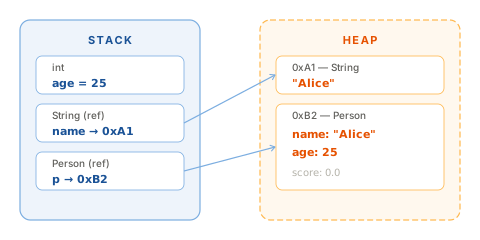
4. Object creation — new and the Heap¶
Creating an object¶
Three things happen in order:
- Heap allocation — the JVM finds free space on the Heap and allocates memory for the object
- Default initialization — fields are set to their zero values (
0,null,false) - Reference returned — the address of the object on the Heap is stored in variable
pon the Stack
Default field values¶
| Type | Default |
|---|---|
int, long, short, byte |
0 |
double, float |
0.0 |
boolean |
false |
char |
' ' |
Object (String, array, ...) |
null |
Local variables have no default
Object fields are automatically initialized. Local variables inside methods are not — reading one before assignment is a compile error.
Multiple references, one object¶
Product a = new Product();
Product b = a;   // b points to the SAME object — not a copy

a.price = 100;
System.out.println(b.price); // 100 — same object
5. The this keyword¶
this is a reference to the object currently executing the method. It is required when a parameter name shadows a field of the same name.
class Circle {
    double radius;

    void setRadius(double radius) {
        this.radius = radius; // this.radius = field; radius = parameter
    }

    double area() {
        return Math.PI * radius * radius; // this is optional here
    }
}
When is this required vs optional?
this is required when a parameter shadows a field. Otherwise it is optional — Java resolves radius to the field automatically when there is no local variable with the same name. Don't prefix every member access with this; it adds noise without clarity.
6. Static vs Instance¶
Instance members¶
Belong to each individual object. Every object has its own copy.
class Counter {
    int count = 0; // instance field — each object has its own

    void increment() { count++; }
}

Counter c1 = new Counter();
Counter c2 = new Counter();
c1.increment();
System.out.println(c1.count); // 1
System.out.println(c2.count); // 0 — unaffected
Static members¶
Belong to the class, shared by all objects. Live in Metaspace.
class Counter {
    static int totalCreated = 0; // shared, lives in Metaspace
    int count = 0;

    Counter() {
        totalCreated++; // every new object increments the shared counter
    }
}

Counter c1 = new Counter();
Counter c2 = new Counter();
System.out.println(Counter.totalCreated); // 2 — accessed via class name
Static methods¶
No this. Cannot access instance fields directly.
class MathUtils {
    static int square(int n) {
        return n * n; // no object needed
    }
}

int result = MathUtils.square(5); // called via class name
| Instance | Static | |
|---|---|---|
| Belongs to | Object | Class |
| Memory | Heap (per object) | Metaspace (shared) |
| Called via | Object reference | Class name |
Has this |
Yes | No |
| Use when | Needs object state | Utility, no state needed |
Anti-pattern: calling static members via an object reference
7. toString(), equals(), hashCode()¶
These three methods are inherited from Object — the root class of every class in Java. The default implementations are rarely useful — most classes should override all three.
toString()¶
Default returns ClassName@hexHashCode — meaningless to any reader.
class Point {
    int x, y;

    Point(int x, int y) { this.x = x; this.y = y; }

    @Override
    public String toString() {
        return "Point(" + x + ", " + y + ")";
    }
}

Point p = new Point(3, 4);
System.out.println(p); // Point(3, 4) — Java calls toString() automatically
Override toString() for readable logs
System.out.println(obj), string concatenation "value: " + obj, and loggers all call toString() automatically. Without an override, logs show com.example.Point@7ef88735 — completely useless.
equals()¶
Default compares addresses (same as ==) — two distinct objects are always false even with identical data.
class Point {
    int x, y;
    Point(int x, int y) { this.x = x; this.y = y; }

    @Override
    public boolean equals(Object o) {
        if (this == o) return true;                    // same address
        if (!(o instanceof Point other)) return false; // wrong type
        return x == other.x && y == other.y;           // compare data
    }
}

Point p1 = new Point(3, 4);
Point p2 = new Point(3, 4);
System.out.println(p1 == p2);      // false — different addresses
System.out.println(p1.equals(p2)); // true — same data
hashCode()¶
Contract: if a.equals(b) is true, then a.hashCode() == b.hashCode() must also be true.
class Point {
    int x, y;

    @Override
    public boolean equals(Object o) { /* ... */ }

    @Override
    public int hashCode() {
        return Objects.hash(x, y); // combines hashes of all fields used in equals()
    }
}
Rule: override equals() → must override hashCode()
If you only override equals(): two equal objects can end up in different HashMap buckets — HashSet.contains() and HashMap.get() return wrong results with no exception or compile error. This is one of the most common silent bugs in Java.
The fast path¶
IntelliJ: Alt+Insert → Generate → equals() and hashCode() generates correct code automatically.
Or use a Record (Java 16+) — toString(), equals(), and hashCode() are generated automatically:
record Point(int x, int y) {} // nothing else needed

Point p1 = new Point(3, 4);
Point p2 = new Point(3, 4);
System.out.println(p1.equals(p2)); // true
System.out.println(p1);            // Point[x=3, y=4]
8. Code example¶
Verified
Full compilable source: OopDemo.java
import java.util.Objects;

public class BankAccount {

    private static int totalAccounts = 0; // static: shared across all instances, lives in Metaspace

    private final String accountId;
    private final String owner;
    private double balance;

    public BankAccount(String owner, double initialBalance) {
        this.owner     = owner;
        this.balance   = initialBalance;
        this.accountId = "ACC-" + (++totalAccounts); // auto-generated unique ID from shared counter
    }

    public void deposit(double amount) {
        if (amount <= 0) return;
        balance += amount;
    }

    public boolean withdraw(double amount) {
        if (amount <= 0 || amount > balance) return false;
        balance -= amount;
        return true;
    }

    public double getBalance() { return balance; }

    public static int getTotalAccounts() { return totalAccounts; } // static: no object needed, call as BankAccount.getTotalAccounts()

    @Override
    public String toString() {
        return accountId + " [" + owner + "] $" + String.format("%.2f", balance);
    }

    @Override
    public boolean equals(Object o) {
        if (this == o) return true;
        if (!(o instanceof BankAccount other)) return false;
        return accountId.equals(other.accountId); // equal if same accountId, regardless of balance or owner
    }

    @Override
    public int hashCode() {
        return Objects.hash(accountId);
    }

    public static void main(String[] args) {
        BankAccount alice = new BankAccount("Alice", 1000);
        BankAccount bob   = new BankAccount("Bob",   500);

        alice.deposit(200);
        bob.withdraw(100);

        System.out.println(alice);                          // ACC-1 [Alice] $1200.00
        System.out.println(bob);                            // ACC-2 [Bob] $400.00
        System.out.println(BankAccount.getTotalAccounts()); // 2

        BankAccount ref = alice;
        System.out.println(alice == ref);      // true — same address
        System.out.println(alice.equals(ref)); // true
        System.out.println(alice == bob);      // false
        System.out.println(alice.equals(bob)); // false — different accountId
    }
}
9. Common mistakes¶
Mistake 1 — Calling an instance method via the class name¶
Dog.bark(); // ❌ compile error — bark() is an instance method, needs an object

Dog rex = new Dog();
rex.bark(); // ✅
Mistake 2 — Forgetting new, using a null reference¶
Product p;
p.price = 100; // ❌ NullPointerException — p points to nothing

Product p = new Product(); // ✅ create the object first
p.price = 100;
Mistake 3 — Overriding equals() but forgetting hashCode()¶
class User {
    String email;

    @Override
    public boolean equals(Object o) {
        if (!(o instanceof User u)) return false;
        return email.equals(u.email);
    }
    // ❌ missing hashCode()
}

Set<User> users = new HashSet<>();
users.add(new User("a@example.com"));
users.contains(new User("a@example.com")); // false — silent bug
Mistake 4 — Calling a static member via an object reference¶
Counter c = new Counter();
int n = c.totalCreated;       // ❌ works but misleading
int n = Counter.totalCreated; // ✅ clearly class-level data
Mistake 5 — Confusing multiple references with multiple objects¶
Product a = new Product();
Product b = a; // b is NOT a copy — it points to the same object as a

b.price = 999;
System.out.println(a.price); // 999 — a and b are the same object
10. Interview questions¶
Q1: What is the difference between a class and an object?
A class is a blueprint that defines structure and behavior — it exists at compile time and its metadata lives in Metaspace. An object is an instance created from that class at runtime — it lives on the Heap. One class can produce many objects; each object has its own copy of instance fields but shares the class metadata and method bytecode.
Q2: What is the difference between == and equals()?
==compares addresses (reference equality) — it returnstrueonly when both variables point to the exact same object on the Heap.equals()compares content (value equality) — its behavior is defined by overriding the method in the class. The defaultequals()fromObjectalso compares addresses, so you must override it to get meaningful value comparison.
Q3: Why must you override hashCode() when you override equals()?
Java's contract: two objects that are equal according to
equals()must produce the samehashCode().HashMapandHashSetusehashCode()to locate the bucket first, then useequals()to differentiate within it. Violating the contract — overridingequals()withouthashCode()— can cause two equal objects to land in different buckets, makingHashSet.contains()andHashMap.get()silently return wrong results with no exception.
Q4: What is the this keyword used for?
thisis a reference to the object currently executing the method. It is used to: (1) disambiguate a field from a parameter of the same name, (2) call another constructor in the same class viathis(...), (3) pass the current object as an argument.thiscannot be used inside a static method because static methods are not bound to any instance.
Q5: Where does JVM store static fields vs instance fields?
Instance fields live on the Heap — each object has its own copy, and they are garbage-collected when the object is no longer reachable. Static fields live in Metaspace (the Method Area) — shared by all instances of the class and alive for the entire lifetime of the class in the JVM.
11. References¶
| Resource | What to read |
|---|---|
| JLS §8 — Class Declarations | Official class specification |
| Oracle Tutorial — Classes | Official tutorial |
| JEP 395 — Records | Records — auto toString/equals/hashCode |
| Effective Java — Joshua Bloch | Item 10: equals(), Item 11: hashCode(), Item 12: toString() |
| Head First Java — Sierra & Bates | Chapter 2: A Trip to Objectville |