Encapsulation and Constructor
1. What is it
Encapsulation is the principle of hiding an object's internal state, allowing access and modification only through a controlled interface.
A constructor is a special method that runs exactly once when an object is created with new — used to initialize fields to valid starting values.
public class BankAccount {
    private double balance; // encapsulation: field is hidden

    public BankAccount(double initialBalance) { // constructor
        if (initialBalance < 0) throw new IllegalArgumentException("Balance cannot be negative");
        this.balance = initialBalance;
    }

    public double getBalance() { return balance; } // controlled access
}
2. Why it matters
Without encapsulation, any code can set a field to a nonsensical value:
// No encapsulation
account.balance = -99999; // nothing prevents this

// With encapsulation
account.setBalance(-99999); // throws IllegalArgumentException — the object protects itself
Together, these two principles protect object invariants — the set of conditions that must always hold throughout the object's lifetime. For example: balance >= 0, name != null, age > 0.
Additionally: - Separates API from implementation — change how data is stored internally without breaking callers - Easier to test — validation logic is in one place, not scattered everywhere - Easier to debug — object in a bad state? Only the setters and constructor need investigating
3. Access Modifiers
Access modifiers control who can access a field, method, or class.
| Modifier | Within class | Same package | Subclass | Everywhere |
|---|---|---|---|---|
private |
✓ | ✗ | ✗ | ✗ |
| (default) | ✓ | ✓ | ✗ | ✗ |
protected |
✓ | ✓ | ✓ | ✗ |
public |
✓ | ✓ | ✓ | ✓ |
Default rule
public class Product {
    private String name;      // only within this class
    private double price;     // only within this class
    int quantity;             // default: same package (avoid in most cases)
    protected String sku;     // package + subclass (use when designing for inheritance)
    public static final int MAX_STOCK = 1000; // constant — public makes sense
}
Start with private and open up only when needed
For fields: always private. For methods: private unless they need to be called from outside. Widening access later is easy; narrowing it breaks existing callers.
protected does not mean 'safer than public'
protected is still accessible from any subclass — including subclasses in other packages. Don't treat it as semi-private. Only use protected when designing an inheritance hierarchy with clear intent.
4. Encapsulation — Getters and Setters
Getters
Return the value of a private field.
public class Person {
    private String  name;
    private int     age;
    private boolean active;

    public String  getName()   { return name; }   // get + FieldName
    public int     getAge()    { return age; }
    public boolean isActive()  { return active; }  // is + FieldName for booleans
}
Getter naming convention
getFieldName() for all types. For boolean, use isFieldName(). Spring, JPA, and Jackson all rely on this convention to auto-bind and serialize objects — a wrong name is a silent bug.
Setters
Allow modification of a field with validation.
public class Person {
    private String name;
    private int    age;

    public void setName(String name) {
        if (name == null || name.isBlank())
            throw new IllegalArgumentException("Name must not be blank");
        this.name = name;
    }

    public void setAge(int age) {
        if (age < 0 || age > 150)
            throw new IllegalArgumentException("Age out of range: " + age);
        this.age = age;
    }
}
When not to write setters
If a field should never change after construction — don't write a setter. Unnecessary setters invite bugs.
public class Point {
    private final int x; // final — cannot be reassigned after construction
    private final int y;

    public Point(int x, int y) { this.x = x; this.y = y; }

    public int getX() { return x; }
    public int getY() { return y; }
    // no setX(), setY()
}
5. Constructor
Syntax
public class Temperature {
    private double celsius;

    // Constructor: same name as class, no return type
    public Temperature(double celsius) {
        this.celsius = celsius;
    }
}

Temperature t = new Temperature(100.0); // calls the constructor
Default constructor
When no constructor is declared, Java automatically generates a default no-arg constructor that does nothing but call super().
Declaring any constructor removes the default
The moment you declare any constructor, Java no longer generates the default no-arg one.
If you need both: declare the no-arg constructor explicitly.Initialization order
When new executes, three steps happen in sequence:
- Heap allocation — JVM finds free space
- Default values assigned to all fields (
0,null,false) - Constructor body executes — overwrites the default values
class Demo {
    int x;      // step 2: x = 0
    String s;   // step 2: s = null

    Demo() {
        x = 42;       // step 3: x = 42
        s = "hello";  // step 3: s = "hello"
    }
}
6. Constructor Overloading and this()
Overloading
Multiple constructors with different parameter lists — Java picks the right one at the call site.
public class Rectangle {
    private final int width;
    private final int height;

    public Rectangle(int width, int height) {
        this.width  = width;
        this.height = height;
    }

    public Rectangle(int side) {          // square
        this.width  = side;
        this.height = side;
    }

    public Rectangle() {                  // default 1×1
        this.width  = 1;
        this.height = 1;
    }
}

new Rectangle(4, 6); // w=4 h=6
new Rectangle(5);    // w=5 h=5
new Rectangle();     // w=1 h=1
this() — constructor chaining
Calls another constructor in the same class. Must be the first statement in the constructor.
public class Rectangle {
    private final int width;
    private final int height;

    public Rectangle(int width, int height) {
        this.width  = width;
        this.height = height;
    }

    public Rectangle(int side) {
        this(side, side);   // calls Rectangle(int, int) — no duplicated logic
    }

    public Rectangle() {
        this(1, 1);         // calls Rectangle(int, int)
    }
}
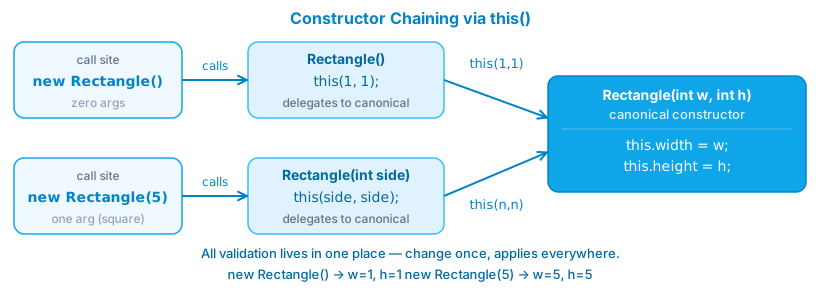
Use this() to avoid duplicating initialization logic
Instead of copy-pasting validation and assignment into every constructor, funnel all of them through the most complete one. When the logic changes, there is only one place to update.
7. Immutability with final
An immutable object cannot be changed after creation. The entire Java standard library is built on this pattern: String, Integer, LocalDate.
public final class Money {             // final class — cannot be subclassed
    private final String currency;     // final field — assigned once in constructor
    private final long   amount;       // smallest unit (e.g. cents)

    public Money(String currency, long amount) {
        if (currency == null || currency.isBlank())
            throw new IllegalArgumentException("Currency required");
        if (amount < 0)
            throw new IllegalArgumentException("Amount cannot be negative");
        this.currency = currency;
        this.amount   = amount;
    }

    public String getCurrency() { return currency; }
    public long   getAmount()   { return amount; }

    // Instead of mutating, return a new object
    public Money add(Money other) {
        if (!this.currency.equals(other.currency))
            throw new IllegalArgumentException("Currency mismatch");
        return new Money(currency, this.amount + other.amount);
    }

    @Override public String toString() {
        return currency + " " + (amount / 100.0);
    }
}
Benefits of immutability: - Thread-safe by default — no synchronization needed, no race conditions possible - Easier to reason about — values never change unexpectedly - Safe to cache and share — no caller can modify what another caller is using
Record (Java 16+) is the fastest path to an immutable class
record Money(String currency, long amount) {
    Money {  // compact constructor — runs validation
        if (currency == null || currency.isBlank())
            throw new IllegalArgumentException("Currency required");
        if (amount < 0)
            throw new IllegalArgumentException("Amount cannot be negative");
    }
}
final fields, field-named getters, toString(), equals(), and hashCode().
8. Code example
Verified
Full compilable source: UserAccount.java
import java.util.Objects;

public final class UserAccount {

    private final String username;  // final: set once in constructor — identity cannot change
    private String       email;
    private int          loginCount;
    private boolean      active;

    // no no-arg constructor — every UserAccount needs a valid username + email from the start
    public UserAccount(String username, String email) {
        this.username   = validateUsername(username);
        this.email      = validateEmail(email);
        this.loginCount = 0;
        this.active     = true;
    }

    private static String validateUsername(String username) {
        if (username == null || username.isBlank())
            throw new IllegalArgumentException("Username must not be blank");
        if (username.length() < 3)
            throw new IllegalArgumentException("Username too short: " + username);
        return username.toLowerCase().trim();
    }

    private static String validateEmail(String email) {
        if (email == null || !email.contains("@"))
            throw new IllegalArgumentException("Invalid email: " + email);
        return email.toLowerCase().trim();
    }

    public String  getUsername()   { return username; }
    public String  getEmail()      { return email; }
    public int     getLoginCount() { return loginCount; }
    public boolean isActive()      { return active; }

    public void setEmail(String email) {
        this.email = validateEmail(email); // reuses validation — one place to update the rule
    }

    public void recordLogin() {
        if (!active) throw new IllegalStateException("Account is deactivated");
        loginCount++;
    }

    public void deactivate() {
        this.active = false;
    }

    @Override
    public String toString() {
        return "UserAccount{username='" + username + "', email='" + email
               + "', logins=" + loginCount + ", active=" + active + "}";
    }

    @Override
    public boolean equals(Object o) {
        if (this == o) return true;
        if (!(o instanceof UserAccount u)) return false;
        return username.equals(u.username); // equal by username only, not email or loginCount
    }

    @Override
    public int hashCode() { return Objects.hash(username); }

    public static void main(String[] args) {
        UserAccount alice = new UserAccount("Alice_Dev", "alice@example.com");
        System.out.println(alice);               // UserAccount{username='alice_dev', ...}

        alice.recordLogin();
        alice.recordLogin();
        System.out.println(alice.getLoginCount()); // 2

        alice.setEmail("alice@newdomain.com");

        // alice.username = "hacker"; // ❌ compile error — private final

        alice.deactivate();
        try {
            alice.recordLogin();
        } catch (IllegalStateException e) {
            System.out.println(e.getMessage()); // Account is deactivated
        }
    }
}
9. Common mistakes
Mistake 1 — Public fields, no encapsulation
// ❌ any code can write directly to the field
public class Circle {
    public double radius;
}

Circle c = new Circle();
c.radius = -5; // meaningless, nothing stops this

// ✅
public class Circle {
    private double radius;
    public Circle(double radius) {
        if (radius <= 0) throw new IllegalArgumentException("Radius must be positive");
        this.radius = radius;
    }
    public double getRadius() { return radius; }
}
Mistake 2 — Forgetting that declaring a constructor removes the default
class Config {
    String host;
    int port;

    Config(String host, int port) {
        this.host = host;
        this.port = port;
    }
}

Config c = new Config(); // ❌ compile error — no no-arg constructor

// ✅ declare it explicitly if needed
Config() { this("localhost", 8080); }
Mistake 3 — Getter returning a reference to a mutable object
// ❌ caller can modify the internal list
public class Team {
    private List<String> members = new ArrayList<>();

    public List<String> getMembers() {
        return members; // dangerous — caller can call .clear() and wipe it out
    }
}

// ✅ return an unmodifiable view
public List<String> getMembers() {
    return Collections.unmodifiableList(members);
}
Mistake 4 — this() is not the first statement
public Rectangle(int side) {
    System.out.println("Creating square"); // ❌ compile error
    this(side, side); // this() must be the first line
}

// ✅
public Rectangle(int side) {
    this(side, side); // first line
}
Mistake 5 — Setter with no validation, getter exposing internal state
public void setAge(int age) {
    this.age = age; // ❌ age = -999 is accepted
}

public Date getBirthDate() {
    return birthDate; // ❌ Date is mutable — caller can modify it
}

// ✅
public void setAge(int age) {
    if (age < 0 || age > 150) throw new IllegalArgumentException("Invalid age: " + age);
    this.age = age;
}

public Date getBirthDate() {
    return new Date(birthDate.getTime()); // defensive copy
}
10. Interview questions
Q1: What is encapsulation and why does it matter?
Encapsulation is the principle of hiding an object's implementation and only exposing what is necessary through a public interface. It matters because: (1) it protects object invariants — fields cannot be set to invalid values, (2) it separates API from implementation — internal changes don't break callers, (3) it centralizes validation in one place rather than scattering it across the codebase.
Q2: What is the difference between private, protected, default, and public?
Access widens in that order:
private(same class only) →default/package-private (same package) →protected(same package plus any subclass) →public(everywhere). Best practice: fields are alwaysprivate, only widened when there is a clear reason.
Q3: What is the default constructor? When does it disappear?
The default constructor is the no-arg constructor (
ClassName() {}) that Java auto-generates when a class declares no constructors. It disappears the moment you declare any constructor — even a parameterized one. If you need both a parameterized constructor and a no-arg constructor, you must declare both explicitly.
Q4: What is the difference between this and this()?
thisis a reference to the current object — used to access instance fields and methods.this()is a call to another constructor in the same class — it must be the very first statement in the constructor and is used for constructor chaining to avoid duplicating initialization logic. They serve entirely different purposes.
Q5: How do you make a class immutable?
Five requirements: (1) declare the class
finalto prevent subclasses from breaking immutability, (2) all fields areprivate final, (3) no setters, (4) the constructor validates all input and initializes all fields, (5) if a field holds a mutable object, return a defensive copy in the getter. The payoff: immutable objects are thread-safe without synchronization.
Q6: Why is returning a mutable List from a getter dangerous?
Because the caller can invoke
.add(),.remove(), or.clear()directly on the object's internal list — breaking encapsulation completely without going through any setter. The fix is to returnCollections.unmodifiableList(list)orList.copyOf(list)so callers can read but not modify.
11. References
| Resource | What to read |
|---|---|
| Oracle Tutorial — Controlling Access | Official access modifier guide |
| JEP 395 — Records | Fastest path to immutable classes |
| Effective Java — Joshua Bloch | Item 15: Minimize mutability · Item 16: Favor composition · Item 17: Design for inheritance |
| Clean Code — Robert C. Martin | Chapter 6: Objects and Data Structures — Law of Demeter |